

German thinkers of the mid twentieth century are valuable today because they got here first. They had seen everything civilised smashed up and ground to bits between 1914 and 1945. To excavate the causes of the catastrophe from among the ruins was a task almost as urgent as finding food, warmth, and shelter in a country which had been devastated physically as well as morally.
Those who had spent the war in safe exile in the USA started first. They had no material cares. The two I have read with attention are Golo Mann and Hannah Arendt. When George W Bush invaded Iraq I started to read Golo Mann’s History of Germany to understand the madness: even then the idea of Weimar America made a lot of sense to me.
And now I am reading Hannah Arendt, long overdue. I hadn’t realised when I got it on Kindle, that The Origins of Totalitarianism is a huge book, 750 pages in paperback. To read it is to be buffeted by the strong mind of a woman who has read everything and expects you to keep up, so I am only half way through but I seem to have taken 7,000 words of notes. Of course these are mostly highlighted passages to work through, copied automatically to my hoarding program; had I copied them out by hand they would have stuck with me better. Nonetheless, certain themes emerge, and one of them is the uncanny prescience with which she describes the rise of MAGA, which is, in her taxonomy, a “mass movement”, not a party or even a mob. If the term has an equivalent today, it would be “populism”
First, a neat, important, point about Faragism:
“When the totalitarian movements invaded Parliament with their contempt for parliamentary government, they merely appeared inconsistent: actually, they succeeded in convincing the people at large that parliamentary majorities were spurious and did not necessarily correspond to the realities of the country, thereby undermining the self-respect and the confidence of governments which also believed in majority rule rather than in their Constitutions.”
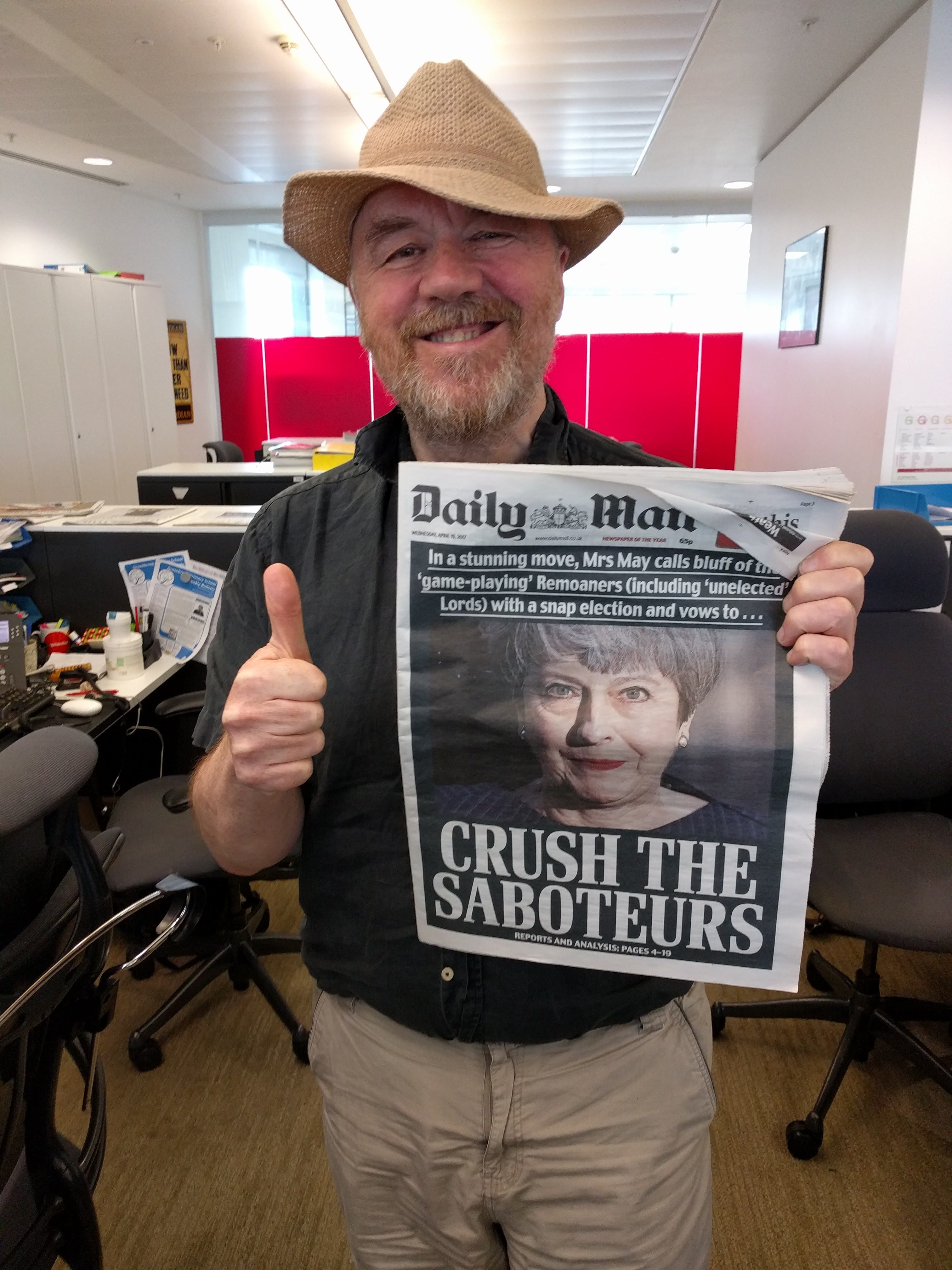
Anyone remember the enemies of the people?
Her description of an online mob is horribly prescient:
The masses grew out of the fragments of a highly atomized society whose competitive structure and concomitant loneliness of the individual had been held in check only through membership in a class. The chief characteristic of the mass man is not brutality and backwardness, but his isolation.
She goes on to say that
Totalitarian movements are mass organizations of atomized , isolated individuals . Compared with all other parties and movements , their most conspicuous external characteristic is their demand for total, unrestricted, unconditional, and unalterable loyalty of the individual member …
Such loyalty can be expected only from the completely isolated human being who , without any other social ties to family , friends , comrades , or even mere acquaintances , derives his sense of having a place in the world only from his belonging to a movement , his membership in the party .
And so you end up with
“a colossal herd, obedient to the arbitrary will of one man, ruled neither by law nor interest, but kept together solely by the cohesive force of their numbers and the conviction of their own holiness.”
There you have MAGA, I think.
I read her account of the masses in the light of the precarity of life as a poor American. It seems to me a country where it is unsafe to trust anyone, or anything. I know this can’t be entirely true. But the precarity around health care, employment, and relationships which is taken for granted in American society – the sense that all relationships of any sort are contractual and so none are binding unless credit card debt is involved – must exact a psychic toll as well as a financial one. Even measured in money terms the outcome is grim. The poorest tenth of Americans mostly don’t have credit cards at all, but if they do they owe almost all their monthly income (85%) just in credit card repayments.
Obviously this is not as shattering as the experience of the central European bourgeoisie after the first world war, and during the Weimar hyperinflation, as Arendt describes them
Inflation destroyed the whole class of small property owners beyond hope for recovery or new formation, something which no monetary crisis had ever done so radically before. Unemployment, when it came, reached fabulous proportions, was no longer restricted to the working class but seized with insignificant exceptions whole nations. Civil wars which ushered in and spread over the twenty years of uneasy peace were not only bloodier and more cruel than all their predecessors; they were followed by migrations of groups who, unlike their happier predecessors in the religious wars, were welcomed nowhere and could be assimilated nowhere. Once they had left their homeland they remained homeless, once they had left their state they became stateless; once they had been deprived of their human rights they were rightless, the scum of the earth. Nothing which was being done, no matter how stupid, no matter how many people knew and foretold the consequences, could be undone or prevented.
But these conditions no longer look wholly impossible, or safely banished to the past and that last sentence catches the flavour of life under Trump very well.
I will come back to what she has to day about refugees and stateless people (again, the term we’d use today is “migrants”) but that really does deserve a post of its own.
Very nice article, Andrew! I think we should also keep in mind our species' evolutionary heritage. We have spent most of this time (~99.9%) in tribal groups competing over limited resources. Our superpower is our sociality. Yet now, and particularly in the US, we stress individualism and self-reliance. And this, not surprisingly, spills over into politics. The correlation in party affiliation with population density is astonishingly high - and so is the suicide rate. Until we are willing to admit (and educate ourselves about) our nature and behave accordingly, I'm afraid we will never solve this problem.
I read your excellent article (clicked through from John Naughton) minutes after listening to Heather Cox Richardson's 26 Oct post describing the 1929 stock market crash. It does indeed feel horribly like history repeating itself. The creation of a society of 'isolated atomised individuals' has very deep roots in our culture. Real change is going to require a shift away from a zero-sum game, and that will require an examination of the individualism that is at the centre of our values.