
Cathy Newman's nothingburger
One last dig into the details of the Smyth scandal

Cathy Newman’s attempt at a hit piece on the Church of England to welcome Sarah Mullally had nothing new in it apart from a law suit aimed at a Cambridge church because (1) it’s rich and (2) Mark Ruston, when he was vicar there, drew up the dossier which got Smyth thrown out of the Iwerne camps in 1982.
The Ruston dossier, had it been shown to the English police, might have led to a prosecution, which might have led to a conviction, which might in turn have led the Zimbabwean authorities to bar Smyth from the country …
But all those “might”s don’t make the argument right. Even assuming the police had wanted to bring a prosecution, none of the victims were willing then to testify, for wholly understandable reasons. Without their evidence the law could not have touched Smyth.
Some of the parents of the children originally abused at Winchester might have gone to the police if they’d known that Smyth was operating in Zimbabwe. One of Makin’s sources suggests that when Smyth’s abuse first came to light, two of the parents of Winchester boys wanted to go to the police; other versions of the story say only one set of parents did. Either way it’s clear that most of the affected parents also wanted a coverup and that those who did not were promised that Smyth would never work with young people again. Had those parents been told that this undertaking was broken they might — again, might — have gone to the police who might have taken seriously their complaints.
To read the story like this is not exactly victim blaming, but it it does point up their share of responsibility for what happened and failed to happen. They had agency. They could have chosen differently and without them a criminal prosecution was impossible. Yet without a successful criminal prosecution. Smyth could not have been kept out of Zimbabwe, or anywhere else. The Church of England has no power over who enters or leaves the country.
Nor is “The Church of England” a coherent body. The Makin report makes it clear that almost everyone in the Church who learned the details of Smyth’s crimes tried very hard to stop him. Two men who did not, and who are as responsible as anyone, are Jamie Colman in England and Richard Johnson in Zimbabwe.
Makin includes in an appendix the report drawn up by David Coltart, the Zimbabwean lawyer who worked as hard as anyone to stop Smyth and bring him to justice. That shows that the Ruston dossier, the most detailed account of Smith’s crimes in Winchester, had reached Zimbabwe in 1989, two years before Guide Nyacheru’s death — but that Smyth and his Zimbabwean supporters refused to accept it.
Sending the Ruston report led – as it was intended to – to a sustained effort on the part of Christians in Zimbabwe to stop Smyth’s work with boys. It was completely unsuccessful. Eventually all the trustees of his charity in Britain resigned in protest at his continuing to work with young people. Perhaps they should at that point have gone to the police or even to the press in Britain. It might not have worked, but nothing else could have stopped Smyth at that point. But it’s easy to see why they didn’t.
The trustees who’d gone were replaced in September 1989 by Jamie Colman who, with his wife, continued to advocate for Smyth, and to support him financially, until 2017. They knew exactly what was happening, as did his Zimbabwean supporters:
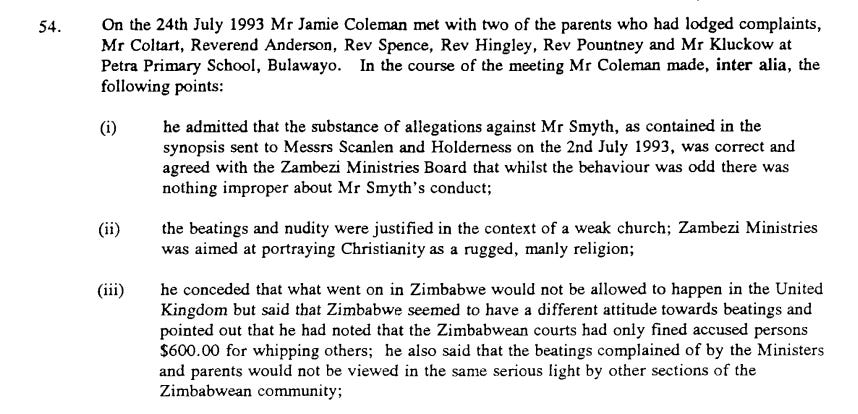
With Colman’s moral, financial, and political support, the camps continued. They were extremely pervy and known to be so. (Amongst other things the boys were encouraged to bounce in the nude on trampolines, an activity known as “flappy jumping” — and what do you think was flapping as they jumped?)
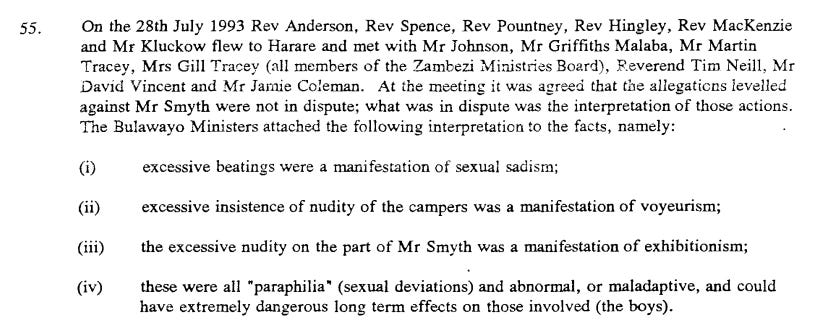
So we look at that list of Smyth’s defenders and enablers in Zimbabwe. Not one represents the Church of England, still less St Andrew the Great in Cambridge. It was Smyth’s supporters in Zimbabwe, not anyone in the Church of England, who wrote a year after Guide Nyacheru’s death that
”It is our belief that [Smyth] is not “sick” or sexually or psychologically disturbed, but is instead a strong, forceful Christian with a deep commitment to converting and disciplining young men, equipping them for life as Christian leaders.
We also believe that his failure in Britain should not be allowed to negate the many successful years of youth work before and since the Winchester incidents.
None of these exculpations of Smyth can be blamed on the Church of England, St Andrew the Great, or Justin Welby personally.
None the less, Cathy Newman said in her report that Welby had been “forced to quit over his failure to do enough to stop abuse by John Smyth” and that the Makin Report “set out the scale of the C of E’s coverup, saying leading figures knew what Smyth was doing and could have stopped him going on to abuse more boys in Zimbabwe and South Africa”; she asked Guide Nyacheru’s sister “Do you think the Church is still covering up for JS now?” and “So what do think of what the Church of England did in terms of covering up what Smyth did?”
I have made similar points on both 'Thinking Anglicans' and 'Surviving Church', also linking the Coltart Report, numerous times over several years. Unfortunately chronology seems to have no meaning for many people (sadly I have to include Mr Makin whose terms of reference specifically instructed him not to judge with hindsight). The greatest irony of all is that Justin Welby promised that all C of E clergy who had been wrongdoers would be brought to book, and he has ended up paying the greatest price of all.
I happened to know one of the bishops (now deceased) told about Smyth around 2013 and since condemned for 'walking away on the other side'. He did not know Smyth, had no means of knowing either the truth or seriousness of the abuse being alleged, none of which took place in his diocese, and I consider it was entirely reasonable with that limited state of knowledge to say that it should be passed to the diocesan bishop where the events occurred.
Nor, seemingly, has anyone picked up the point that at that time if the allegations proved unfounded they would have been potentially libellous.
Some people have registered likes on this site. Though once an admirer of Andrew Brown, I just want to register a dislike. I think Cathy Newman is onto something and Sarah Mulally's refusal to give Channel 4 an interview since her appointment speaks volumes and was a huge mistake.